See full event note here
See resource list for decolonizing trauma and healing here
Message from PoliSci Grads:
Hi, what does unwellness and/or numbness feel like?
Months of ongoing genocides that your labor and money directly contribute to, “this is what our ruling class has decided will be normal” (Aaron Bushnell).
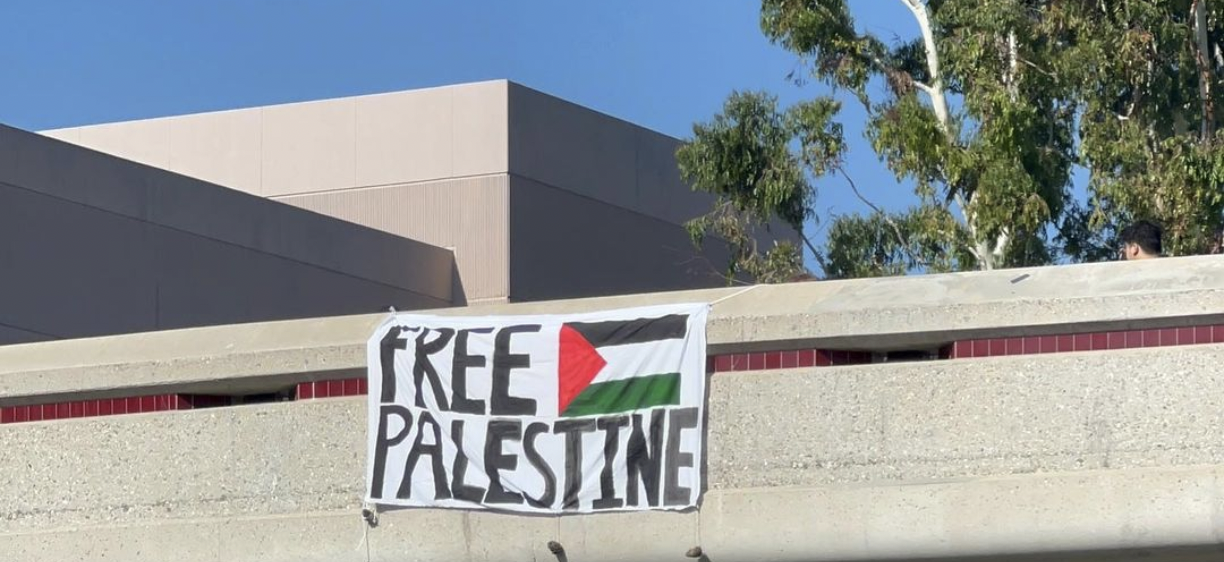
This is an ongoing psychological warfare and counter-insurgent population control that requires trauma-informed responses. In our own department, UCI Political Science, we are told that nothing can be done about the punishment of pro-Palestinian student protests at UCI. We are told that decolonial methods are not legitimate. We are told that an Israeli “expert on Hamas” can tell us the truth about Palestinian wounds: unfortunate collateral damage inflicted by a right-wing government’s counter-terrorist military strategies. We are told that our own professor is given millions of dollars to do research on how our anti-Israel dissents on campus are anti-semitic, which requires increased policing and surveillance at UCI. We are told that if we are secular, if we work hard, if we are professional and respectable, if we are non-violent, if we become lawful participants of the civil society and liberal democracy, if we trust this university, this country, and international law, if we forget who we are and where we come from, and most importantly, if we condemn all our relatives who are terrorists, criminals, rioters, anarchists, bad apples, etc., things will be all good.
We know that these are colonial lies camouflaged as civilizational missions, which we refuse to take part in. This was why we organized our first event, The Unspeakable Gaza, to try to speak some sense into the void.
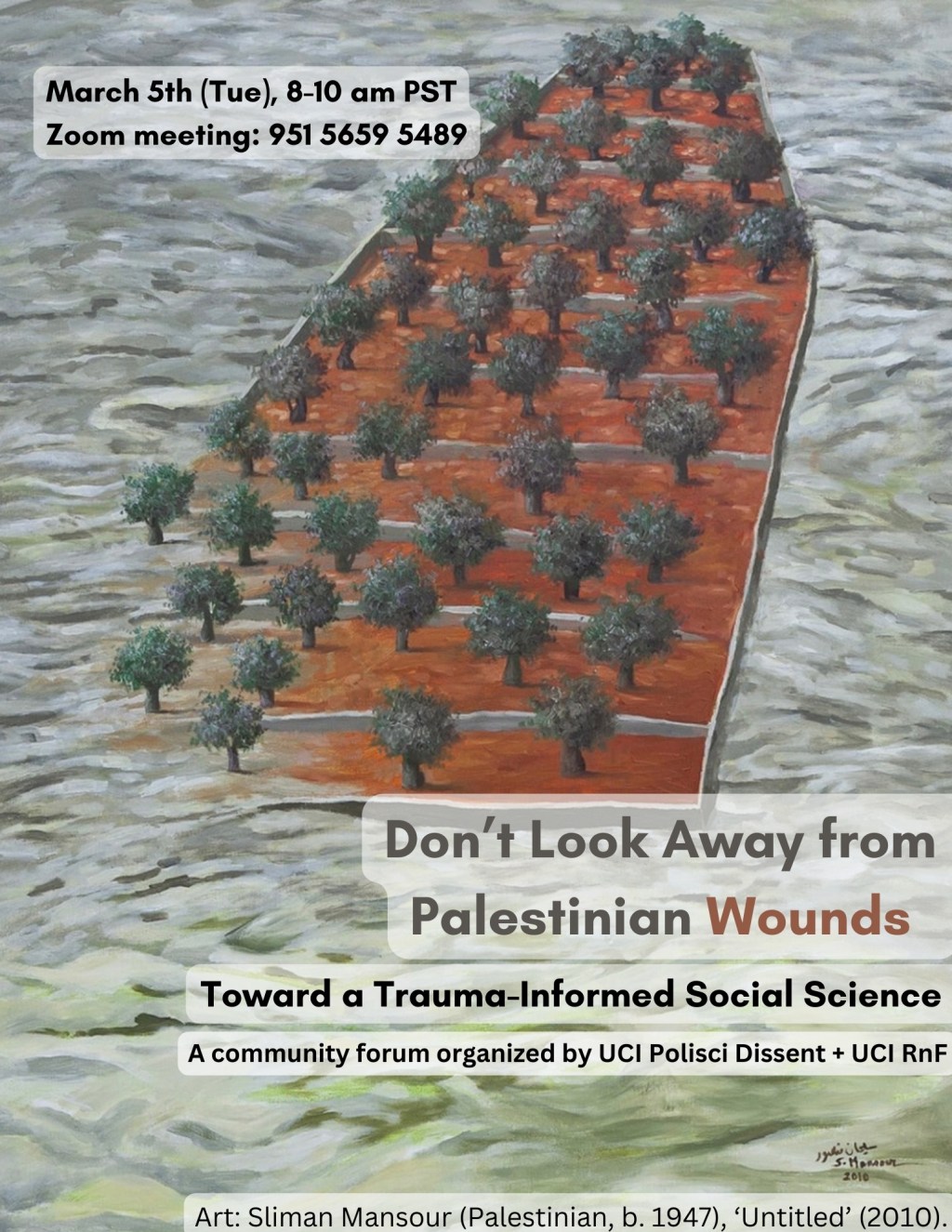
Our upcoming community forum, “Don’t Look Away from Palestinian Wounds: Toward a Trauma-Informed Social Science”, is organized in hope of cultivating a radical tenderness in this collective work. We know that the medical-psychiatric industrial complex works to serve the state, and we are not interested in a depoliticized trauma framework. Therefore, we want to be absolutely explicit about the political and decolonial nature of this project. This is about cultivating the affective capacity to be an accomplice, one who is able to work against her own colonial agreements, to look at the system in its eyes, to sit with her own complicity, to let go of her own entitlements, to think and act seriously against them instead of using activism and advocacy as coping mechanisms, and to imagine and enact worlds otherwise.
If this is the kind of space you want to be in, welcome. The event will be on March 5th, 8:00-10:00 AM PST, via Zoom (link here). Co-sponsored by the UCIRNF Collective and Polisci Grads for Peace, we compiled a list of resources on political trauma and healing for you, which will continue to be developed during our event. We are honored to have Prof. Davin Phoenix, Dr. Misbah Hyder (Alum), Nahreen Aref (polisci grad), and Daniel Rodriguez Ramirez (UCSC social psychology grad) to join our forum as roundtable speakers. During the first hour we will discuss the questions below. The second half of the event will be open discussions between our speakers and audience, all are welcome to participate.
Please circulate the event info to your trusted circles at UCI. We look forward to holding this space and fostering a sustainable, caring, and accountable community together with all of you.
Roundtable questions
1. How to have trauma-informed praxis?
– What is trauma? What does it mean to be trauma-informed?
– How does your own works (scholarly and beyond) address political traumas?
– In academic spaces and beyond, how do you communicate with other people in political discussions about Palestine and decolonization in general?
2. How is trauma getting weaponized or depoliticized in the political contexts you work on? And how do they connect to Palestinian struggles?
– What’s the relationship between trauma discourses and settler colonialism?
– What are alternative frameworks for understanding and talking about trauma, without its weaponization and depoliticization (e.g. Decolonizing Therapy, a recent book by Jennifer Mullan)?
3. How does political science and/or social science help or get in the way of understanding the emotions or affect of political trauma, anger, joy, and more, in the context of Palestine?
– How do you think existing literature in political/social science helps understand the affective and emotional aspects of the Palestinian struggle?
– What needs to be changed, expanded, or abolished in social science in order for us to be properly trauma-informed?
4. What does true political healing look like to you?
 Rank and File Irvine
Leave a comment