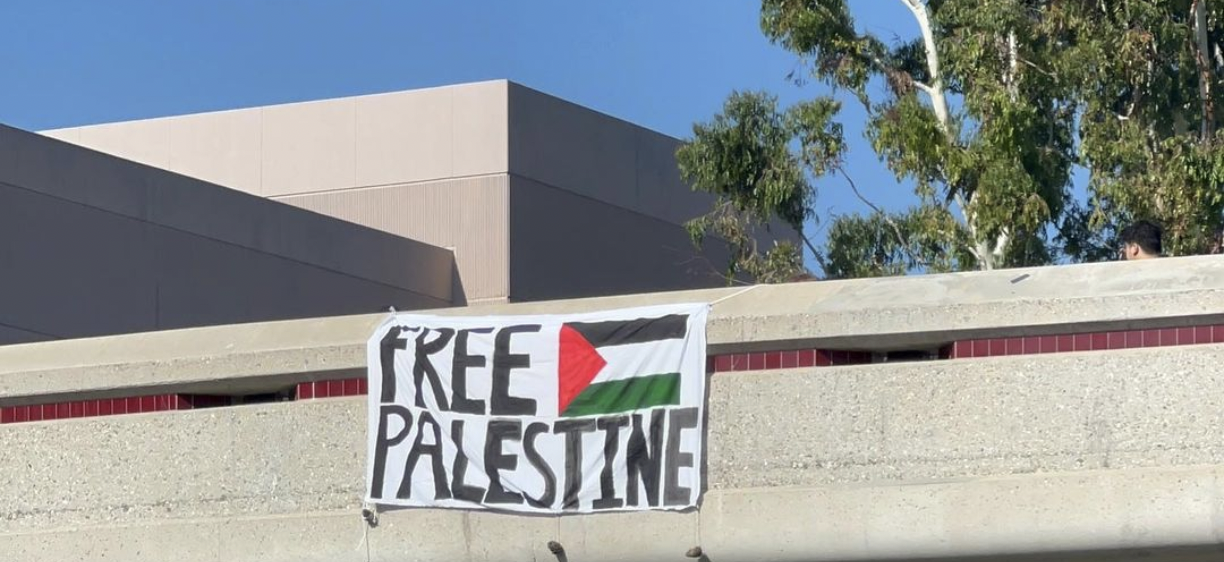
Chancellor Gillman,
We are writing this letter as graduate students who feel compelled to respond to your recent campus-wide email deceptively titled “Amidst Profound Tragedy: Our Shared Commitment to Humanity and Understanding.” Despite your implication at the front-end of the statement that your role as Chancellor is fundamentally ‘apolitical’, your condemnation of what you call the “horrific massacre of innocent individuals in Israel by Hamas” is not about a shared commitment to humanity, nor to understanding: it is a continuation of the violent, one-sided, colonial and white supremacist narratives that have for decades been circulated by mainstream US news and media outlets. Despite recently “declaring” war, Israel has been waging war on Palestine and Palestinian people since 1948. The goal of a Zionist project and the later Israeli state, in the words of the founding theorists themselves, has always been the total annihilation of Palestinian life, marked by the refusal to even recognize Palestinians as humans. Early Zionists even referenced Palestine as a “a land without a people for a people without a land,” openly admitting that Palestinians, living in the land, could not qualify as a “people.” Theodor Herzl, a foremost leader of the early Zionist movement wrote in 1904 that Israel would be “a portion of the rampart of Europe against Asia, an outpost of civilization as opposed to barbarism.” Your statement omits the crucial context of an ongoing settler-colonial project, one which was envisioned by the British almost a century ago, and continues to wreak havoc on all life in historic Palestine today.
This is why there is no “shared humanity” without an acknowledgement that Palestinians have been systemically and historically deprived of any appeals to humanity, to being a living, breathing people. Though you profess an apolitical viewpoint in the statement, refusing to engage with Palestinian history is in and of itself a political choice, and one that obscures why your appeal to “shared humanity” is incomplete. Not only have Palestinians been historically denied this understanding, but there is also no humanity in the conditions of the Gaza Strip, which has been besieged for 17 years, declared an open-air prison by the UN, and been deprived of food, water, and healthcare for the entirety of this illegal siege. In the latest tragic updates to this ongoing violence, Yoav Gallant (Israel’s Minister of Defense) stated that they are fighting human “animals.” Just in the last week, the people of Gaza have been subjected to an onslaught of indiscriminate bombing, with schools, hospitals, churches, mosques, and refugee camps decimated, along with the decision to cut off their water and electricity. Banned white phosphorus bombs have rained down on Palestinians. How can we speak of shared humanity when the conditions of Palestinians, past and present, highlight the theft of their humanity? In light of this, where is your condemnation of the present violence imposed upon a collective of innocent civilians? With over a thousand people dead in Gaza, where is the condemnation for the mass killing of a people already dispossessed? Why are their lives not worth mourning?
The proliferation of one-sided statements with support for Israel but no acknowledgement of the word Palestine itself lays the preconditions for this ongoing project of extermination. By focusing your statement solely on Israel and then calling for peace, you contribute to the historical and ongoing erasure of Palestinians. Further, this does not functionally help us move towards a world where all life is precious: a goal that we share and yearn for. You are instead parroting a dominant discourse wherein the settler state can claim a monopoly on an ongoing regime of asymmetrical violence, one which has never been condemned historically and gains increasing media and academic support today, as sitting Senator Lindsey Graham declares that “we are in a religious war,” and we must “level the place” in reference to Gaza on Fox news and Nikki Haley demands we “finish them” in reference to Palestinians. Benjamin Netanyahu, the Israeli Prime Minister recently declared that “Israel will win this war, and when Israel wins, the entire civilized world wins.” This is genocidal rhetoric, with familiar echoes in our recent history. Without vigilance against parroting hegemonic talking points and an attention to historical context in our statements, we perpetuate cycles of colonial violence, and we risk tacit support for the same destructive US-backed wars that have destroyed countless lives in the last two decades alone. This is we are deeply appalled by your failure to place the recent events in Gaza within the context of the past 75 years of Israeli apartheid, settler colonialism, genocide, and violent dispossession and ethnic cleansing of Palestinian people and land. Why no mention of the fact that Israel is the most powerful country in the Middle East, supported financially and militarily by the US, the most powerful and war-hungry country in the world? Why no calls for Israel to “defend” itself “peacefully”? Why only the condemnation of colonized peoples who have for decades been struggling to create life, remain in their homes, remain on their land, in what the Israeli state has turned into an “open air prison”? Why no mention of the hundreds of Palestinian people slaughtered or exiled or imprisoned daily by the Israeli state, which operates with complete impunity, and billions in public and private funding from the US? Further, the statement, in its sole focus on the events that took place in Israel implies a discontinuity that obscures the context of 1) The subsequent bombardment of the Gaza Strip by the Israeli military and 2) The continued economic deprivation resulting from Israel’s blockade of the region that has been in place since 2007. The omission of the above-mentioned structural violence is telling, and belies any efforts towards unification on the basis of a “common humanity” that Palestinians have never been granted access to by their oppressors.
Without this context, your statement that the recent uprisings in Palestine are “the largest one-day slaughter of Jews…since the end of the Nazi holocaust” supports what both the US and the Israeli state, and mainstream news and media narratives, have also done for decades: weaponizing the Holocaust and anti-semitism to valorize Palestinian genocide, and punish or excommunicate anyone who condemns it. Nonetheless, there are millions of Jews, including Holocaust survivors, across the world who adamantly oppose the death-dealing visions and operations of Zionism and the Israeli state, and who unwaveringly support Palestinian uprisings for liberation and self-determination. This—recognizing that oppression is the root of violence— is what it means to be committed to humanity and shared understanding. A true interest in a shared commitment to humanity and understanding would require that you correct the destructive and ahistorical narrative you have circulated to students and faculty across campus. It would require that you center the voices of Palestinians fighting against what Holocaust survivor Gabor Maté rightly terms the “longest ethnic cleansing operation in the
20th and 21st centuries.” It would also mean you consider what it means to be Palestinian on this campus, to have loved ones under siege and facing an onslaught of never-ending violence. Your statement not only obscures real pain, suffering, and death, it has contributed to a culture of fear amongst Palestinians and allies for their liberation that is not unfamiliar on campuses across the nation. When speaking up for Palestine comes with the threat of violence, surveillance, and the loss of entire careers, it becomes especially important to not only analyze what such powerful control over the discourse obscures and what its final purpose might be, but also then to stand up for what is right and affirm the safety, right to life, and belonging of Palestinians both in their land and on this campus. You have students, on all sides, who are in mourning right now. Refusing to acknowledge the breadth of their perspectives does not uplift shared humanity, so much as it contributes to the wholesale exclusion of certain parties from it. Following Israel’s recent decision to cut Gaza’s electricity and communication towers, Dr. Mustafa ElMasry of the Gaza Mental Health Program sent a final message saying that “there will be a day where we confront our oppressor and demand justice. Given humanity’s condition during these interesting times, this day will not be in this world. You do me a last favor by spreading my words of agony, the least we deserve is that humanity hears our cries of pain.”
Chancellor Gillman, we call on you to work meaningfully to your stated goal of shared humanity by retracting your harmful statement.
Sincerely,
UCI Graduate Students
 Rank and File Irvine
Leave a comment